
Snow on Solar Panels in Wisconsin: Clear It or Leave It
Updated
Get a free quote
We reply with a price. Nothing is booked until you say yes.
Rather talk? Call (608) 352-4700 or text us.
What to expect
Part of Roof Snow Removal.
How much energy snow actually costs
A study funded under a U.S. Department of Energy contract measured six systems in Colorado and Wisconsin through two winters, 2010-11 and 2011-12. Monthly losses from snow reached as high as 90 percent, and losses as a share of a whole year of production ranged from 1 to 12 percent. A literature review of the field reached the same shape: annual losses under 10 percent in most climates, winter months often above 25 percent, and no proven way to avoid the loss.
Winter here is also the thin part of the solar year. Janesville gets about 78 percent of its 36.6 inches of yearly snow from December through February (28.6 inches), which are also the months with the least sun. A bad month for an array is a small part of the year's total, which is why the annual number is so much lower than the monthly one.
Why the snow comes off on its own
The Wisconsin study built its model on snow sliding off the modules, driven by sunlight on the panel and air temperature. Tilted glass is slick, and a dark panel under snow warms in sun faster than the snow around it. That is the reason the Department of Energy advises clearing snow from the ground or roof around the system so the snow can shed, which gives the sliding snow somewhere to go.
When clearing makes sense
The DOE guidance for winter storms is short:
- Remove snow from the panels only if there is a substantial accumulation and a risk of overload from an incoming storm.
- If you must, remove it gently with a broom and not a shovel.
- Inspect the system after the storm before powering it back on, and have a trained professional look it over after an extreme event.
Overload is rarely a Janesville problem. Rock County houses are designed for a 30 pound per square foot roof snow load under the Wisconsin dwelling code, and FEMA puts a foot of light, dry snow at about 3 pounds per square foot and a foot of wet, heavy snow at about 21. The roof can carry it. The harder case is a wet storm on top of an old pack, covered in how much snow a roof can hold.
What goes wrong when people rake panels
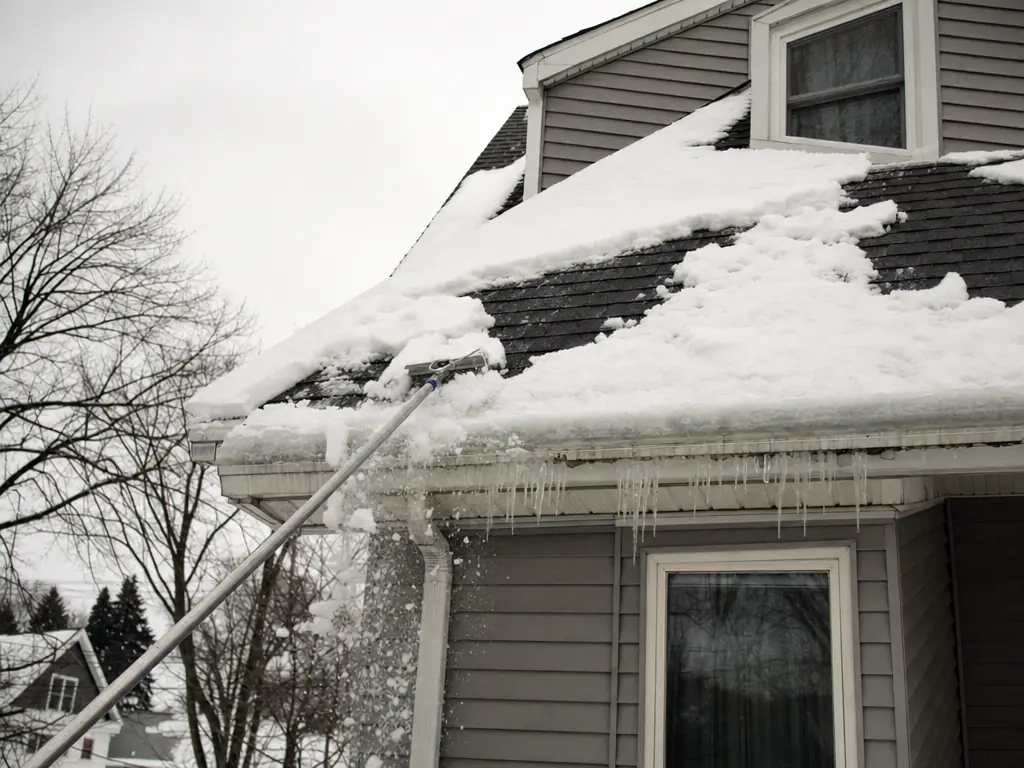
A Swedish research institute tested snow removal on rooftop modules over three winters. Its roof rake with a slide on the head was the most effective and easiest to use, and a rectangular roof rake struggled with dry, wind-packed snow that stuck to the glass. A long handle with a heavy head was hard to control: in one case the head was dropped onto a module and cracked a cell. The same study found cell damage in the other groups and the control group, from loads far below the modules' rating, and none in the slide-rake group. It also found that leaving a few centimeters of snow reduced the risk of damaging the module on the final pass, and that mild, sunny days made the job easiest.
That is one test in one climate, and it says the roof rake is not harmless. Before anyone touches the glass, read your panel maker's warranty terms and ask your installer what they allow. A scraped coating or a cracked cell is not the kind of damage most people notice until output drops.
A ground-level job, or a job for someone else
A ground-mount array can often be cleared from the ground with a soft broom. A roof array is the part to hand off, because the work is a slippery roof and live electrical equipment. Roof snow removal here runs $200 to $700, and a crew that knows the job can clear around the array without standing on it. The service is on the roof snow removal page, and every price is on the cost page. If ice is forming at the eaves below the array, that is ice dam removal, and the long-term fix is in how to prevent ice dams in Wisconsin.
A simple rule for a Janesville winter: if the array is on the roof, leave it through a normal storm, and call someone only for an unusually deep or icy pack. If it is on the ground and covered for days after a storm, clear it with a soft broom from the side, a little at a time.
More on snow removal in Janesville: what we do, what it costs and how to get a quote.
Sources (8)
- Measured and modeled photovoltaic system energy losses from snow for Colorado and Wisconsin locations, Solar Energy (2013)
- Pawluk, Chen and She, photovoltaic electricity generation loss due to snow: a literature review, Renewable and Sustainable Energy Reviews 107
- U.S. Department of Energy FEMP, solar photovoltaic hardening for resilience: winter weather
- RISE, evaluation of snow removal methods for rooftop photovoltaics (three winters, Piteå, Sweden)
- Wisconsin Admin. Code SPS 321.02, loads and materials (Uniform Dwelling Code)
- FEMA P-957, Snow Load Safety Guide
- NOAA NCEI, U.S. Climate Normals 1991-2020, station Afton - Janesville WWTP (USC00470045)
- Housecall Pro, snow removal price guide 2026
Want a price for your own place?
Call, text, or send the form. You get a written price back before anything is scheduled.
Quick answers
Should I remove snow from my solar panels?
The Department of Energy says to remove snow only when there is substantial accumulation and a risk of overloading the array, using a broom and not a shovel. Otherwise panels shed snow as the sun warms them.
How much power do solar panels lose to snow in Wisconsin?
A study of systems in Colorado and Wisconsin found monthly losses as high as 90 percent and annual losses of 1 to 12 percent. A literature review puts annual losses under 10 percent in most climates.
Can I use a roof rake on solar panels?
A Swedish three-winter test found a roof rake with a slide on the head worked best and caused no cell damage, while a heavy rectangular rake head dropped on a module cracked a cell. Check the panel warranty before using any tool.
Can my roof handle snow on top of the solar array?
Rock County houses are designed for a 30 pound per square foot roof snow load under the Wisconsin dwelling code, and a foot of light snow weighs about 3 pounds per square foot. Wet, heavy snow and ice weigh several times more.
Keep reading
- How Much Snow a Roof Can Hold in Wisconsin (Rock County)
- How to Prevent Ice Dams in Wisconsin: Attic, Vents, Rake
- Homeowners Insurance and Ice Dams in Wisconsin: What Is Covered
- How Much Snow Janesville, WI Gets (Averages by Month)
- Slip and Fall on Ice in Wisconsin: Who Is Liable
- Best Ice Melt for Concrete in Wisconsin, and How Much
Rather not shovel it yourself?
Tell us the address, the driveway and the walks. We reply with a per-push price and a season price before the first visit.