
How Much Snow a Roof Can Hold in Wisconsin (Rock County)
Updated
Get a free quote
We reply with a price. Nothing is booked until you say yes.
Rather talk? Call (608) 352-4700 or text us.
What to expect
Part of Roof Snow Removal.
The roof snow load in Rock County: 30 pounds per square foot
Wisconsin's Uniform Dwelling Code says roofs must be designed and built to support the minimum snow loads on the state's zone map, with the load assumed to act straight down on the roof area as seen from above. The map, Figure 321.02, has two zones: Zone 1 across the north at 40 pounds per square foot (psf) and Zone 2 across the south at 30 psf. Rock County sits on the state line in the southern zone, so a house in Janesville, Beloit, Milton, Edgerton or Evansville built to the dwelling code is designed for 30 psf.
Wisconsin's map is simpler than the national model code's. A 2025 briefing for the state's Uniform Dwelling Code Council noted the current code has two snow zones, 30 to 40 psf, while the national model code uses six areas from 25 to 60 psf.
The design load is what the framing is built to carry with a safety margin, and it assumes the framing is in good shape. Plenty of Rock County homes predate today's code: the county's median home was built in 1970, and 19.2% were built before 1940. A guideline from the Insurance Institute for Business and Home Safety (IBHS) is that a typical roof can handle about 20 psf of snow before it is stressed, and less on an older roof or one that has had problems.
How much snow weighs on a roof
Depth tells you very little. Weight depends on how much water is in the snow, and the spread is huge:
| What is on the roof | Weight |
|---|---|
| 1 foot of light, dry snow | About 3 lb per sq ft |
| 1 foot of wet, heavy snow | About 21 lb per sq ft |
| 10 to 12 inches of fresh snow | About 5 lb per sq ft (one inch of water) |
| 3 to 5 inches of old, packed snow | About 5 lb per sq ft (one inch of water) |
| 1 inch of ice | A little under 5 lb per sq ft |
| 1 foot of ice | About 57 lb per sq ft |
FEMA and the building-safety groups give working densities for estimating a roof by hand: roughly 5 to 20 pounds per square foot for each foot of light snow, 20 to 40 for packed snow, 40 to 58 for packed snow with ice, and 58 for ice. The figures round a little differently, but they agree on the point that matters: an inch of ice weighs about as much as a foot of fresh snow.
Janesville's average snow, in pounds
The Janesville weather station averages 36.6 inches of snow a year and 10.8 inches in January, the snowiest month. It averages 2 days a year with 5 inches or more, and a 10-inch day comes about once a decade (0.1 days a year).
Our arithmetic with the IBHS figure: if an entire average January fell as fresh snow and none of it melted or blew off, it would weigh roughly 5 psf, far under the 30 psf design load. Ordinary Janesville snowfall is not what collapses roofs. The risky winters stack things up: a heavy, wet storm on top of an old pack, rain soaking into snow that is already there, ice building at the eaves, or wind drifting snow against a higher wall or into a valley. IBHS says more than about 2 feet of old, packed snow could be too much for a typical roof. How much and when the snow comes is in how much snow Janesville gets.
Estimate your own roof load in three steps
- Measure the depth on a part of the roof you can see from the ground, or on open ground nearby, in feet.
- Pick a density: fluffy new snow, settled and packed snow, or snow with ice layers in it (the UW-Extension ranges above).
- Multiply. UW-Extension's formula is depth in feet times density. Two feet of packed snow at 20 to 40 comes to 40 to 80 psf, past a 30 psf design load.
Low-slope and flat roofs, garages, porches, sheds and additions with a lower roof under a taller wall are the places to watch, because snow piles up and stays there. Steeper roofs shed more of it.
Warning signs a roof is carrying too much snow
UW-Extension lists the signs that a structure is under stress from snow: sagging, trusses that are bowed or out of alignment, and creaking sounds. If you see or hear any of those, keep people out of that part of the building and get the snow off by someone who knows how to do it without adding weight or damaging the roof.
Ice at the eaves is its own problem. A ridge of ice is heavy on the overhang, and the water that ponds behind it finds its way under the shingles. The cause and the fix are in how to prevent ice dams, and steam removal of a dam that has already formed is on ice dam removal.
When to clear the roof, and how
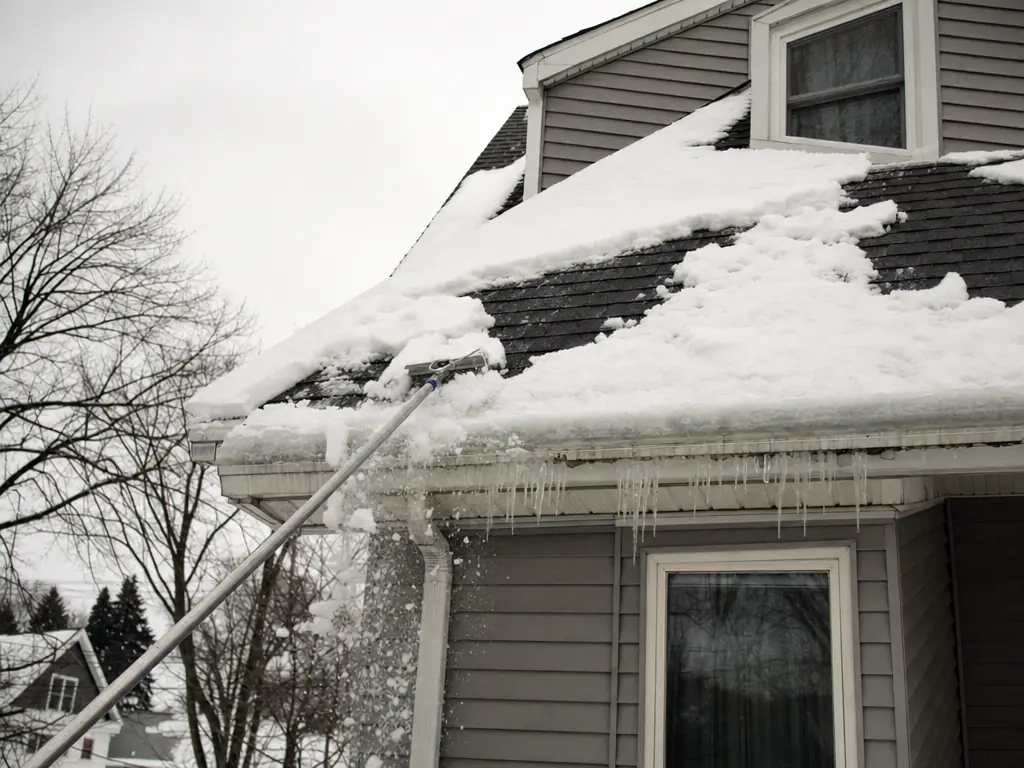
Wisconsin's insurance commissioner tells homeowners to pull snow off the bottom portion of the roof with a roof rake or push broom from the ground, and not to climb onto the roof or chip at the ice, which damages shingles and risks a fall. Clearing roof snow runs about $200 to $700 a visit. The service is on roof snow removal and every price is on the cost page.
If snow weight does damage the house, whether a policy pays depends on its form. The Broad Form lists the weight of ice, snow or sleet as a covered peril. That is in homeowners insurance and ice dams in Wisconsin. While you are outside with the rake, check that furnace and dryer vents and the gas meter are not buried (what to clear besides the driveway), and if the work is too much, see snow help for seniors.
More on snow removal in Janesville: what we do, what it costs and how to get a quote.
Sources (10)
- Wisconsin Admin. Code SPS 321.02, loads and materials (Uniform Dwelling Code)
- Wisconsin DSPS, Uniform Dwelling Code ch. SPS 321 with Figure 321.02, zone map for roof loads
- Wisconsin DSPS, Uniform Dwelling Code Council meeting packet
- U.S. Census Bureau, ACS 2020-2024 5-year, via Census Reporter
- Maine Emergency Management Agency, removing snow from roofs (IBHS guidelines)
- FEMA P-957, Snow Load Safety Guide
- UW-Extension Lincoln County, snow loads on farm buildings
- NOAA NCEI, annual snowfall normals 1991-2020, USC00470045
- Wisconsin Office of the Commissioner of Insurance, winter weather tips press release
- Housecall Pro, snow removal price guide 2026
Want a price for your own place?
Call, text, or send the form. You get a written price back before anything is scheduled.
Quick answers
How much snow can a roof hold before it collapses?
A new house in Rock County is designed for 30 pounds per square foot under Wisconsin's Uniform Dwelling Code. IBHS puts a typical roof at about 20 pounds before stress shows. Depth alone does not answer it, because wet snow and ice weigh several times more than fluffy snow.
How much does a foot of snow weigh on a roof?
From about 3 pounds per square foot for light, dry snow to about 21 pounds for wet, heavy snow. A foot of ice weighs about 57 pounds per square foot.
Should I remove snow from my roof in Janesville?
Clear it when the pack is deep and heavy, when a flat or low-slope roof is holding drifts, or when ice dams are forming. Use a roof rake from the ground; Wisconsin's insurance office warns against climbing on the roof or chipping ice. See roof snow removal.
What are the signs of too much snow on a roof?
Sagging, trusses that are bowed or out of alignment, and creaking sounds, per UW-Extension. If you notice any of them, keep people out of that area and have the snow removed.
Keep reading
- How to Prevent Ice Dams in Wisconsin: Attic, Vents, Rake
- Homeowners Insurance and Ice Dams in Wisconsin: What Is Covered
- How Much Snow Janesville, WI Gets (Averages by Month)
- Clear Snow From Gas Meters, Furnace Vents and Hydrants
- Free Snow Shoveling Help for Seniors in Rock County, WI
- Shoveling Snow and Your Heart: What Studies Show
- Per Push vs Seasonal Snow Contract: the Janesville Math
Rather not shovel it yourself?
Tell us the address, the driveway and the walks. We reply with a per-push price and a season price before the first visit.