
Best Ice Melt for Concrete in Wisconsin, and How Much
Updated
Get a free quote
We reply with a price. Nothing is booked until you say yes.
Rather talk? Call (608) 352-4700 or text us.
What to expect
Part of Salting and Ice Control.
How the City of Janesville treats its own streets
The city's Operations Division uses de-icing chemicals as its main tool for any storm under 2 to 3 inches, and it puts them down early, because chemical applied at the start of a storm keeps snow and ice from bonding to the pavement and makes plowing easier. Arterial and collector streets are usually treated as soon as snow starts to stick, and a typical de-icing run takes about 6 to 8 hours. In sleet, freezing rain or freezing fog, the city says de-icing is the only thing that works.
A driveway works the same way on a smaller scale. Shovel or plow first, then treat what is left, and treat early on an ice morning instead of trying to melt a frozen inch of slush at noon. How the city's plows run, and when your street gets its turn, is in how Janesville plows its streets.
How much ice melt a driveway actually needs
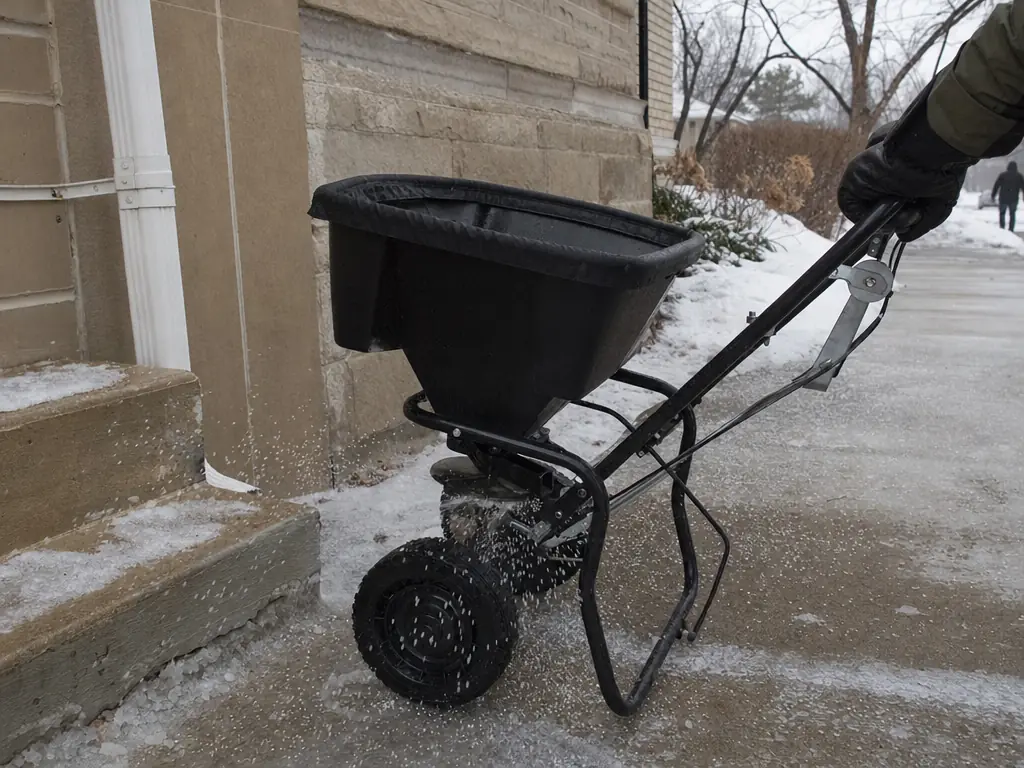
Much less than most people pour. Wisconsin Salt Wise, the salt reduction group the Wisconsin DNR quotes in its winter advice, says a 12-ounce coffee mug of salt is enough for an entire 20-foot driveway or 10 sidewalk squares, scattered so there is space between the grains. Grains piled on top of each other do not melt more ice. They wash into the street and the storm sewer.
Temperature decides how fast salt works, and below about 15 degrees it barely works at all:
| Pavement temperature | Ice melted by one pound of rock salt | Time it takes |
|---|---|---|
| 30°F | 46.3 lb | 5 minutes |
| 25°F | 14.4 lb | 10 minutes |
| 20°F | 8.6 lb | 20 minutes |
| 15°F | 6.3 lb | 1 hour |
| 10°F | 4.9 lb | Dry salt blows away before it melts anything |
Those melt times are for pavement temperature, which on a sunny afternoon can run warmer than the air and before dawn can run colder. On a 10-degree morning, salt is wasted money. Sand gives traction right away and keeps working in any cold.
Which ice melt works at which temperature
The temperature printed on the bag is often the eutectic point, the lowest temperature at which the chemical can melt anything in a lab. Wisconsin Salt Wise tells people to pick by the lowest practical melting temperature instead, and warns there is no truth-in-labeling rule for deicers:
| Product | Lowest practical melting temperature | Notes |
|---|---|---|
| Calcium chloride | -20°F | Works in the deepest cold |
| Potassium acetate | -15°F | Check the label for this one |
| Magnesium chloride | -10°F | Also used as a brine before a storm |
| Sodium chloride (rock salt) | 15°F | Stops working on the coldest mornings |
| Calcium magnesium acetate (CMA) | 20°F | Chloride-free, works only near freezing |
| Sand or other abrasives | Never melts | Traction only, at any temperature |
Blends land somewhere between their ingredients, and Salt Wise says to check with the manufacturer. Most Janesville snow falls in December, January and February (28.6 inches of the 36.6 inches average). On the mornings when the pavement is below 15 degrees salt does little, which is why a bag of sand by the door is worth keeping even if you salt. How often the snow comes, month by month, is in how much snow Janesville gets.
Best ice melt for concrete driveways and walks
The Wisconsin Ready Mixed Concrete Association puts it plainly: the most damaging thing for a new concrete surface is deicer, especially in the first winter. Its advice:
- Avoid deicers entirely the first year after the concrete is poured. Use sand for traction.
- Never use deicers that contain ammonium nitrate or ammonium sulfate. They are sometimes packaged and sold as ice melt, and they rapidly break down concrete. Lawn fertilizers with those chemicals, or with urea, can do the same.
- After the first winter, sodium chloride (rock salt) or calcium chloride may be used, with caution, and a sealer applied after finishing helps the surface hold up.
So the practical answer for most Janesville driveways: sand on anything poured this year, a light scatter of rock salt on older concrete when it is above 15 degrees, calcium chloride used sparingly for the deep-cold mornings, and a shovel before any of it. Brick and stone take damage too. Public Health Madison and Dane County lists the concrete, brick and stone around our homes among the things salt weakens.
Ice melt, pets and plants
The Wisconsin DNR says road salt can irritate a pet's paws and cause other health problems if it is eaten. The fix is mostly using less: scatter instead of pour, sweep up the dry leftovers once the ice is gone, use sand on the coldest days, and wipe paws after a walk on a salted sidewalk.
Plants get it through the soil. Salt changes the makeup of the soil and slows plant growth, so pile shoveled snow from a salted walk away from shrubs and garden beds when you can. If your snow ends up on a neighbor's side or near the street, the rules on where it is allowed to go are in pushing snow into the street.
Where the salt goes after the thaw
It does not go away. One teaspoon of salt is enough to make five gallons of water toxic for freshwater organisms, the DNR says, and chloride stays in the water permanently. The DNR measured about 600,000 tons of chloride a year in the state's rivers in the early 2000s and nearly 800,000 tons a year by 2018. Fifty Wisconsin rivers and streams and one lake are listed as impaired by chloride, mostly from winter salt, and every one of the state's 43 long-term trend monitoring sites shows chloride rising. Most wastewater treatment plants are not built to remove chloride either.
That is the case for the coffee-mug rule. Less salt costs less, works the same, and keeps the concrete, the lawn and the water in better shape.
Ice on the walk and Janesville's 12-hour rule
Janesville's sidewalk ordinance covers ice as well as snow, so a walk that was shoveled but left as a sheet of ice is still not clear (the sidewalk rules). Ice is also where most winter falls and injury claims start. Who is responsible when someone slips is covered in slip and fall liability in Wisconsin. If shoveling and salting are getting harder to keep up with, see shoveling and your heart and snow help for seniors in Rock County.
We salt walks, steps and drives after a plow visit and on freezing-rain mornings. The Wisconsin range for a salting visit is $20 to $60. Details are on salting and ice control, and every price is on the cost page. If you sign a seasonal contract, check whether salt is included or billed per visit. That line is on the snow contract checklist.
More on snow removal in Janesville: what we do, what it costs and how to get a quote.
Sources (10)
- City of Janesville, plowing and salting operations
- Wisconsin Salt Wise, smart winter salting
- Wisconsin Salt Wise, product options (deicer melting temperatures and melt times)
- NOAA NCEI, U.S. Climate Normals 1991-2020, station Afton - Janesville WWTP (USC00470045)
- Wisconsin Ready Mixed Concrete Association, proper winter care
- Public Health Madison and Dane County, be salt wise this winter
- Wisconsin DNR, reduce salt use this winter
- Wisconsin DNR, help protect our waters by reducing winter salt use
- Madison Metropolitan Sewerage District, winter salt reduction toolkit
- Wisconsin Homeowners Guide, snow removal in Wisconsin (2026 cost guide)
Want a price for your own place?
Call, text, or send the form. You get a written price back before anything is scheduled.
Quick answers
What is the best ice melt for concrete?
For concrete less than a year old, plain sand. The Wisconsin Ready Mixed Concrete Association says to avoid deicers the first winter. After that, rock salt or calcium chloride used sparingly, and never a product containing ammonium nitrate or ammonium sulfate.
How much salt should I put on my driveway?
About one 12-ounce coffee mug for a 20-foot driveway or 10 sidewalk squares, scattered so there is space between the grains. Shovel first and sweep up dry leftovers afterward.
At what temperature does rock salt stop working?
Around 15 degrees pavement temperature, per Wisconsin Salt Wise. Below that it melts very little. Calcium chloride works down to about -20 degrees, and sand gives traction at any temperature.
Is ice melt safe for dogs?
Road salt can irritate paws and cause health problems if a pet eats it, the Wisconsin DNR says. Using less, choosing sand on the coldest days and wiping paws after walks all cut the exposure.
Keep reading
- City of Janesville Plowing: When and How Streets Get Cleared
- Janesville Sidewalk Snow Removal Rules: the 12-Hour Ordinance
- Slip and Fall on Ice in Wisconsin: Who Is Liable
- Shoveling Snow and Your Heart: What Studies Show
- Free Snow Shoveling Help for Seniors in Rock County, WI
- Pushing Snow Into the Street in Wisconsin (Janesville Rules)
- How Much Snow Janesville, WI Gets (Averages by Month)
- Snow Removal Contract Checklist: Free Template Terms
Rather not shovel it yourself?
Tell us the address, the driveway and the walks. We reply with a per-push price and a season price before the first visit.