
Snow Fence for a Driveway: Janesville Rules and Setback
Updated
Get a free quote
We reply with a price. Nothing is booked until you say yes.
Rather talk? Call (608) 352-4700 or text us.
What to expect
Part of Driveway Snow Plowing.
Is snow fence allowed in Janesville?
Not as an everyday yard fence. The city's fence ordinance says temporary fencing "such as plastic or wood-slat snow fencing shall be prohibited in all zoning districts, except as a temporary use for a special event, hazard, or construction warning." It also says a temporary fence has to come down within 24 hours after the event ends or when "the condition or season for which the said fence was erected no longer exists," and that temporary fencing may not be used to enclose yard space. Keeping drifts off a driveway is not one of the listed uses, so as written the ordinance does not give you one. Ask the Building Division before you put stakes in the ground.
A permanent fence is a different path and has its own limits under the same section: a permit for any fence 16 feet or longer, a semi-transparent fence (at least half see-through) up to four feet in the front setback area, privacy fence no higher than 30 inches in the front and corner side setback areas, and up to six feet along interior sides and the back in residential districts. None of those numbers are about snow, so a fence that fits the code still may not stop a drift.
This is Janesville's code. Beloit, Milton, Edgerton, Evansville and the surrounding towns write their own fence rules, so ask the city or town before you buy rolls of fence.
Where WisDOT puts a snow fence
The state's highway maintenance manual is the most specific public guide to placement, and it is written for roads. It says snow fences "can be effective in preventing snowdrifts, improving visibility, and reducing slush and ice," and it also warns that "improper designs can actually make a drifting problem worse". Its rules:
- Put fences where drifting is a continuing problem, which tends to be the same spot year after year.
- Set the posts before the ground freezes and hang the fence, pulled taut, after it freezes.
- Hang the fence one foot above the ground, leaving a gap underneath.
- Place it a distance of 35H from the edge of the shoulder, where H is the height of the fence.
- Wood, metal or plastic fence can be used.
Our arithmetic with the 35H rule: a 4-foot fence goes about 140 feet from the edge it protects, and a 6-foot fence about 210 feet. That is why snow fence is a rural tool. A town lot does not have the room, and a fence 20 feet from a driveway would not follow the manual. There is no separate number for a private driveway, so treat 35H as the starting point and let a person who has watched your drive drift tell you where the wind comes from.
Corn rows and living fence on farm ground
On farmland WisDOT uses standing corn instead of fabric. Its program pays landowners to leave at least 12 rows of standing corn planted parallel to the road, between 75 and 150 feet from the edge of the pavement, at $150 per 100 feet of standing corn. The same flyer cites national research that plowing snow costs 100 times what trapping it with a snow fence does. The manual also lists snow windrows built in fields and living snow fence, meaning shrubs and trees, as options for severe drifting.
If you own rural acres with a long drive, the useful part is the idea, not the dollars: a row of crop or a hedge upwind of the drive does the work of a fence, and it is not a temporary fence under the city code. Whether it fits your township's rules is a question for the town.
What a fence will not fix
A fence stops wind-blown drift, not snowfall. After a storm the drive still needs to be plowed. Janesville averages 36.6 inches of snow a year and 12.7 days with an inch or more, and a fence changes none of that. Where it helps is the second day, when wind refills a drive that was plowed clean. A rural drive of 300 feet or more runs $60 to $120 a push at the going rate, and a refill visit can be billed as a push, so ask the plow service ahead of time how it treats wind-only returns. That question and the gravel-drive details are in plowing a long or gravel driveway.
Cheaper moves than a fence
- Push piles well back and wide in early winter so the wind has less to pick up and the next storm has room.
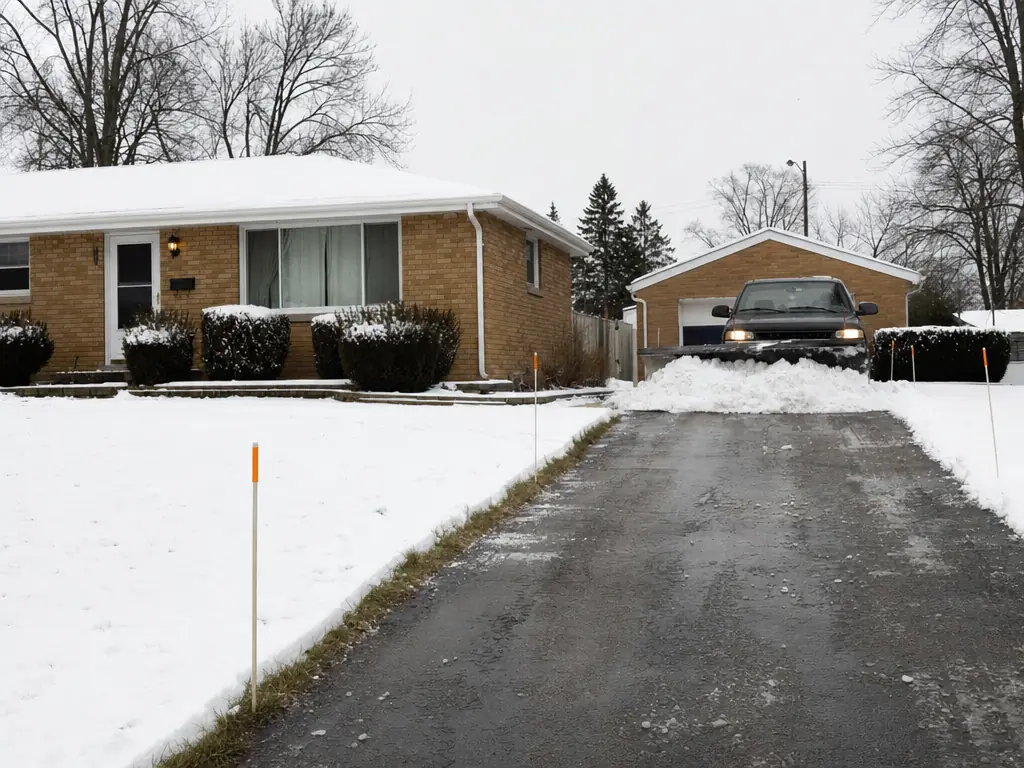
- Mark the drive edges with stakes before the ground freezes so the plow stays on the drive.
- Tell the plow service exactly where your drive drifts and from which direction.
- Put it in writing: the contract checklist lists the return visit and where snow is stacked.
The service itself is on the driveway snow plowing page, and seasonal contracts cover repeat visits on a rural drive for a flat price.
More on snow removal in Janesville: what we do, what it costs and how to get a quote.
Every snow removal price on this site is on the snow removal cost page.
Sources (5)
- Janesville Code of Ordinances, sec. 42-356, fences (Municode)
- WisDOT Highway Maintenance Manual 06-15-40, drift prevention
- WisDOT, Wisconsin's Standing Corn Row Snow Fence Program
- NOAA NCEI, annual snowfall normals 1991-2020, USC00470045
- published 2026-27 residential rates from a Janesville-area snow removal company
Want a price for your own place?
Call, text, or send the form. You get a written price back before anything is scheduled.
Quick answers
Can I put up a snow fence in my yard in Janesville?
Janesville code 42-356(h)(2) prohibits plastic and wood-slat snow fencing in all zoning districts except for a special event, a hazard or construction warning. Ask the Building Division before installing one for drifts.
How far from the road should a snow fence be?
WisDOT places highway snow fence a distance of 35 times the fence height from the edge of the shoulder, hung one foot off the ground. For a 4-foot fence that is about 140 feet.
Does a snow fence stop all drifting?
No. WisDOT says a properly placed fence can be very effective, and also that an improper design can make drifting worse. It does not replace plowing after a storm.
What is the standing corn row snow fence program?
WisDOT pays landowners $150 per 100 feet to leave at least 12 rows of standing corn parallel to a road, 75 to 150 feet from the pavement edge.
Keep reading
- Plowing a Long or Gravel Driveway in Rural Rock County
- Snow Plow Trigger Depth: The Inches Before a Plow Comes
- City Plow Filled the End of Your Driveway: What to Do
- Pushing Snow Into the Street in Wisconsin (Janesville Rules)
- Snow Removal Contract Checklist: Free Template Terms
- Per Push vs Seasonal Snow Contract: the Janesville Math
- How Much Snow Janesville, WI Gets (Averages by Month)
Rather not shovel it yourself?
Tell us the address, the driveway and the walks. We reply with a per-push price and a season price before the first visit.