
Shoveling Snow and Your Heart: What Studies Show
Updated
Get a free quote
We reply with a price. Nothing is booked until you say yes.
Rather talk? Call (608) 352-4700 or text us.
What to expect
Part of Sidewalk Snow Removal.
What the snow shoveling studies found
The largest look at snow shoveling injuries comes from researchers at Nationwide Children's Hospital, who studied U.S. emergency department records from 1990 through 2006 and published in the American Journal of Emergency Medicine in January 2011. The headline numbers:
| Finding, U.S. emergency departments 1990 to 2006 | Number |
|---|---|
| People treated for snow shovel injuries and emergencies | about 195,100 |
| Average per year | about 11,500 |
| Share of cases that were cardiac | 7 percent |
| Share of the deaths that were cardiac | all 1,647 |
| Heart symptoms, age 55 and older vs younger | 4.25 times as likely |
| Most often injured body area | lower back, 34 percent |
Cardiac cases were few but the most serious, making up more than half of the hospital admissions as well as every death. The most common causes of injury overall were muscle strain from the effort (54 percent of cases), slips and falls (20 percent) and being hit by the shovel (15 percent).
The injuries that are not heart attacks
The same study shows what sends most shovelers to the emergency room. Soft tissue injuries were 55 percent of the diagnoses, cuts 16 percent and broken bones 7 percent. After the lower back, the most injured areas were the arms and hands (16 percent) and the head (15 percent). Slips and falls were one in five of the injuries, so a cleared walk still needs salt or sand where ice is left underneath (which ice melt to use). The release also notes these events reach children as well as adults, so the shovel is not a job to hand a young kid on a heavy-snow morning.
Why shoveling snow is hard on the heart
The American Heart Association's 2020 scientific statement on exercise-related heart events names snow shoveling as an activity that can put extra stress on the heart, especially for people who do not exercise regularly. Barry Franklin, the statement's lead author, says that in his research participants' heart rates passed 85 percent of their maximum after only two minutes of shoveling, a level expected in an intense treadmill test. The reasons he gives:
- It is mostly arm work, which is harder on the heart than leg work.
- Lifting a heavy shovelful makes people hold their breath, which spikes heart rate and blood pressure.
- You stand mostly still, so blood pools in the legs instead of returning to the heart.
- Breathing cold air narrows blood vessels, raising blood pressure and constricting the coronary arteries.
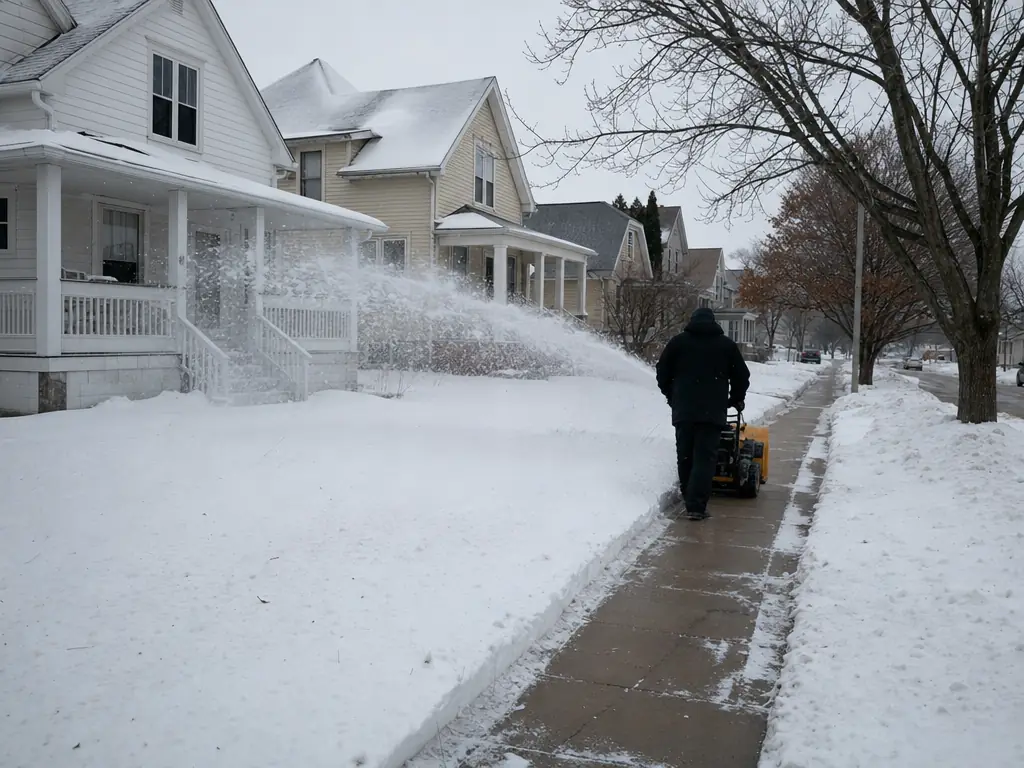
The same release compares the two machines in your garage: running a snow blower raises the heart rate to around 120 beats a minute, against around 170 while shoveling.
Heart attacks the day after a big snow
A study in the Canadian Medical Association Journal followed every heart attack hospital admission and death in Quebec from November through April, 1981 to 2014: 128,073 admissions and 68,155 deaths. Among men, 20 centimeters of snow (about 8 inches) was tied to 16 percent higher odds of a heart attack admission and 34 percent higher odds of a heart attack death the next day, compared with no snow. Two or three days in a row of 5 centimeters or more also raised the odds. Women showed no increase, and the authors suspect shoveling is the reason, since men are more likely to do it.
What that means here: Janesville counts 2 days a year with 5 inches or more and 0.1 days a year with 10 inches or more. Big storms are rare, which is part of the danger: the AHA warns about people who are inactive most of the year and then shovel a heavy snowfall once or twice a winter. Month-by-month numbers are in how much snow Janesville gets.
Who should not shovel snow
The AHA's first tip is direct: if you have known or suspected heart disease, or risk factors for it, get someone else to clear your snow. Add anyone 55 or older who is not active the rest of the year, given the 4.25 times figure above, and anyone who has been told by a doctor to avoid heavy exertion. For older homeowners on a budget, the free and low-cost options are in snow help for seniors in Rock County.
Safer shoveling if you do it yourself
The AHA's tips, in the order it gives them:
- Start gradually and pace yourself.
- Cover your mouth and nose, and wear layers, a hat and gloves.
- Push or sweep the snow rather than lifting and throwing it.
- Be extra careful in wind, which makes the cold hit harder.
- Use a snow blower instead of a shovel when you can.
Clearing more often in a long storm keeps each load lighter. See how many inches before plowing for how crews decide when to go out. The heaviest snow on most properties is the packed ridge the city plow leaves across the driveway apron (the city plow windrow), so that is the pile to hand off first. Wet, heavy snow also loads the roof. See how much snow a roof can hold before climbing a ladder with a rake.
Warning signs: stop and call 911
The AHA says to stop right away if you feel chest pain or pressure, lightheadedness, heart palpitations or an irregular heartbeat, and to call 911 if the symptoms do not ease soon after you stop. Its list of heart attack signs also includes pain in the jaw, neck, back, arm or shoulder, shortness of breath, and nausea. Do not finish the driveway first.
The Janesville deadline is what makes people push through
Janesville gives the occupant 12 hours after the snow stops to clear the public sidewalk, and after a complaint the city clears it and bills the owner. A storm that ends at 10 p.m. is due at 10 a.m., which is how people end up shoveling heavy snow in the cold before work. The rules for each city are in the sidewalk snow rules.
Handing it off costs less than people expect: walks added to a plow visit run about $20 to $50 a visit, and a standard driveway $40 to $75 a push (every range is on the cost page). See sidewalk snow removal, or put the whole winter on one price with a seasonal contract. Salt for the steps afterward is covered in the ice melt guide.
More on snow removal in Janesville: what we do, what it costs and how to get a quote.
Sources (6)
- Watson et al., Snow shovel-related injuries and medical emergencies treated in US EDs, 1990 to 2006, American Journal of Emergency Medicine (2011)
- Nationwide Children's Hospital, national study of snow shoveling injuries (news release)
- American Heart Association, snow shoveling and cold temperatures (news release)
- Auger et al., Association between quantity and duration of snowfall and risk of myocardial infarction, CMAJ (2017)
- NOAA NCEI, annual snowfall normals 1991-2020, USC00470045
- City of Janesville, snow and ice covered sidewalks
Want a price for your own place?
Call, text, or send the form. You get a written price back before anything is scheduled.
Quick answers
Can shoveling snow cause a heart attack?
It can trigger one in people at risk. A 17-year U.S. study found that every one of the 1,647 deaths tied to snow shoveling was cardiac, and a Quebec study found more heart attacks among men the day after heavy snow.
Is a snow blower easier on your heart than a shovel?
A snow blower raises the heart rate to around 120 beats a minute, compared with around 170 for shoveling. It is still exertion, so pace yourself either way.
Who should not shovel snow?
The American Heart Association says anyone with known or suspected heart disease or its risk factors should have someone else do it. People 55 and older were 4.25 times as likely to have heart symptoms while shoveling in the U.S. study.
What should I do if my chest hurts while shoveling?
Stop immediately. The American Heart Association says to call 911 if chest pain, pressure, lightheadedness or an irregular heartbeat does not ease soon after you stop. Leave the rest of the driveway for someone else.
Keep reading
- Free Snow Shoveling Help for Seniors in Rock County, WI
- Janesville Sidewalk Snow Removal Rules: the 12-Hour Ordinance
- How Much Snow Janesville, WI Gets (Averages by Month)
- Snow Plow Trigger Depth: The Inches Before a Plow Comes
- City Plow Filled the End of Your Driveway: What to Do
- Best Ice Melt for Concrete in Wisconsin, and How Much
- Per Push vs Seasonal Snow Contract: the Janesville Math
- How Much Snow a Roof Can Hold in Wisconsin (Rock County)
Rather not shovel it yourself?
Tell us the address, the driveway and the walks. We reply with a per-push price and a season price before the first visit.